Theatre […] is one of the loveliest ways to spend time with people. It’s creative, and emotional and funny, and serious, and we get to hang out.
Born ‘02 in Heidelberg, Rin Fischer (they/them) is now a fully grown adult studying art history and English. They are an enthusiast of independent theatre both within university and outside. In their free time they enjoy table-top RPGs, bouldering, and, occasionally, sleeping.
They enjoy many forms of visual art and have been prone to try out any medium if given the appropriate amount of unrelated deadlines. The self-identifying frog connoisseur otherwise greatly enjoys spending time with friends and loved ones and would do so all the time if they weren’t, unfortunately, an introvert.
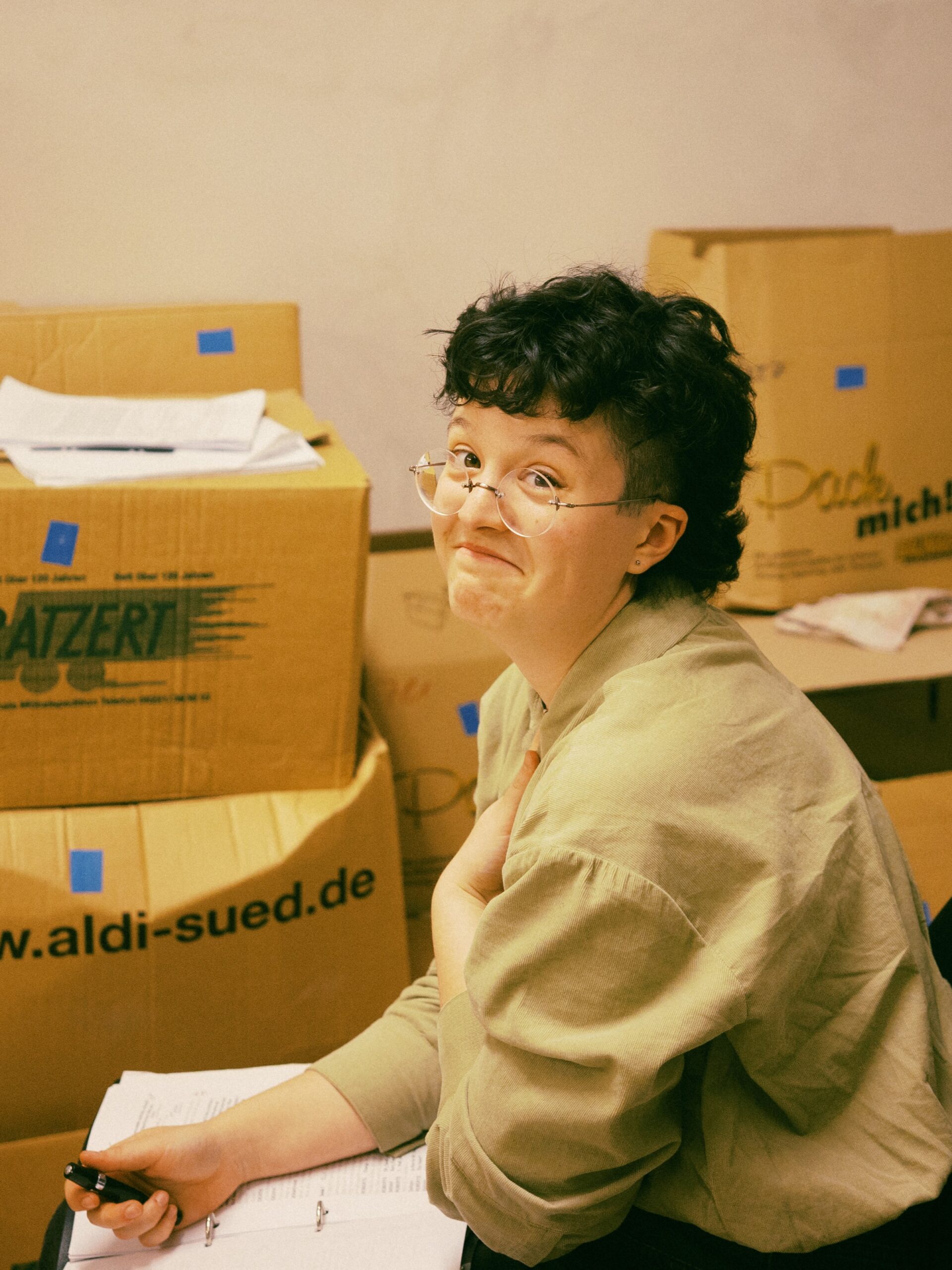
Dubious basements are an important part of theatre, actually!
Interview with the author
by Francis Hyperion on 3rd December 2025.
So. I guess one of the first questions that I think a lot of people are going to have is how come that you, in a place in your life given that we are all pretty young, how come that death was on your mind so much that it became the subject matter for an entire play?
I mean, Death is to an extent a subject matter that everyone needs to deal with every single day. I’ve been lucky enough not to have a lot of family tragedies in my life so far. I’ve been to a very small number of funerals. But I remember that both when I turned ten and when I turned twenty, these bigger self-imposed milestones that you put on life, the thoughts of death prevailed in my brain a little stronger in the sense of like ‘Oh, that’s already ten years gone, that’s another ten years gone, how many more of these ten years will I get until I’m dead?’ I’m not particularly religious, so thoughts of an afterlife are crazy. It sounds a little delusional, to be honest, because thinking about it biologically, you see a dead bird and there is nothing happening with that bird anymore, and I don’t assume that there’s much going on with the bird somewhere else now. And as such, I don’t think there will be a lot happening with me anymore once I am dead. Existence is just such a precious, funny, little thing that you get and you don’t remember what Existence is like before you exist, so you can’t really guess what it’s gonna be like after. And thoughts of that just kinda prevailed in my brain. I mean, when I turned twenty it was after two years of Covid and two years of not really doing a lot with my life and then there was the fear of time kinda running away from me. I’m twenty and I’m wasting away…. It just stuck. And I’m better now.
That’s good to hear.
Yeah, but death is kinda just one of those topics that we all gotta deal with. I conceived of this at a funeral of someone that I didn’t really know, but I was surrounded by people who were grieving very intensely. And I was just there, feeling super out of place, and then I was thinking of what would a situation like this look like for people who don’t know what death is, who don’t have a way to conceptualise it. And I put some of my own thoughts on death in the play. There is one scene in the third Act, when we rehearsed it for the first time I just couldn’t give any feedback on, because I was like ‘Oh fuck, that’s just my thoughts unfiltered’. This is current me talking to me from three years ago. This is not the characters. This is just a conversation with myself.
I think, a lot of what the play is about, outside of the surface-level subject matter of Death as a foreign, unknown concept, is the inability to articulate thoughts, feelings and situations.
Yes.
And the kinds of problems that arise when there’s no language for certain states of being and ideas. Is that also something that arose during the writing process, consciously or unconsciously?
Definitely consciously, I think. It is something that I have said many times, as someone with recently diagnosed ADHD and theorised, peer-reviewed Autism, I feel like I started out in life, with everyone else having been given a manual on how Life works, and I didn’t. And I’m just kind of flailing, not really knowing how to say anything. And that combined with the interesting thing that German is my mother tongue, but I have a lot of problems articulating how I feel in German, because I just, I think there are some studies on this, actually, I think so much more about the individual meaning of every word in German than I do in English. I think much less about the connotation of every single word in English. It’s much easier for me to tell someone, ‘I love you’ than to say ‘Ich liebe dich’. Those are just completely different for me, even though technically they mean the same thing. It’s just easier to say in English. Also, I just find language and a lack of vocabulary to be a super fascinating thing. In Town, you’ve got all these problems that, even if the vocabulary isn’t there, still need to be talked about, so you talk about them in different ways. And I think that’s just a normal way to deal with everything, because talking about things head-on is really difficult. So I think it was very much a conscious decision.
And you can read the inability to talk about things also as a system of oppression that is upheld. And I think we are introduced to the figures of authority in the town fairly clearly. These are figures that uphold a broken system. They then go about fixing that system with a top-down approach that goes horribly wrong. This play is very complex and has a lot of different layers to it. I was wondering, with these two men and the younger woman who was pulled into keeping the secret, with no fault of her own, are there analogies that can be made between this and capitalism or systemic queerphobia?
Everything I write is existential and queer.
(laughs) Yeah.
(laughs) No question there. That’s just who I am, existential and queer. The choice with Roberts and Denvers, it’s two white men in their 50s-60s, who very much embody the conservative mindset of: ‘Everything is going to stay the way it is’. And then in a way, they also pull other people into that. Younger people, who don’t necessarily want to, but don’t feel safe enough to stand up against that. And it’s absolutely an analogy that this conservative system is being dismantled by a young bisexual man and a transgender woman. That’s there. Make of it what you wish, but I am saying things with it.
Yes. So then, from the process of you being at this funeral, you had thoughts about it, you sat down and started writing, to this is a full-blown play that you are directing and producing, with a full cast. How did that come about? What was the process there? Because I think there’s a jump from ‘This is a story I have in my head’ to ‘We are going to perform it in January’
Yeah, it’s insane. I started writing Town as a novella because I was writing a lot of prose at the time. Jumping from prose to a script seemed kind of crazy, so I wanted to write the whole thing in prose first, before I’d turn it into dialogue. Unfortunately, prose takes a lot of time. I wrote a lot of it in a couple of weeks, then my mental state wasn’t the greatest for a time, and when I finally had the headspace to think about it again, I decided to just write it as a script. I wanna see it done, I wanna see it finished, I want to have this thing. But there was like a year and a half between those two states. What really kept me going were you, Jonah and Alpine. I remember when I wrote just a couple of chapters of this and sent it to people, and one of Jonah’s comments was: ‘I can’t wait to see it on stage at some point’.
Which is ironic, because now he’s in it.
He doesn’t get to see it, he is on stage, actually. And just your and Alpine’s enthusiasm for this story, even though it wasn’t finished, it was just a first Act essentially, that kept me going so much. Most things that I do, I am very self-conscious about, that unfortunately includes my writing.
It shouldn’t.
I know, I’m learning that as we speak. Then, you know, life happened and I, in another state of hyperfocus, wrote this whole play out. I tried to figure it out again and again, until we were at the version that we have now. There were some story beats I knew were going to happen from the beginning, and then it was just a thing of ‘I want to see it finished’, and then it was. I sent it to friends, and there was never a question of ‘Are we gonna do this?’, it was a question of ‘When are we doing this.’ And I just decided, let’s do it after Vogelfrei season, let’s do it in winter. And now we’re doing it.
And it’s going great, thus far.
I think when the scripts were printed and we did our first reading in July, I was like ‘Oh. This is happening’
Yeah.
And I mean, I don’t think it would be happening to the extent it is without the enthusiasm of literally everyone involved in the project, which is a gift unlike anything else I have ever seen. Because it is the first time I am putting something that I’m writing out into the world, but it’s also twelve people that I really like ‘yes-and’ing me so hard that we’re doing it. It’s really great.
Did anything surprise you thus far, in the directing process?
(laughs) That if you have a group of just very competent, interested, enthusiastic people, that directing isn’t particularly hard. Because we do a scene for the first time and I give you three pointers, and then you do it again and it’s infinitely better than the first go and only gets better from there. The way that the scenes progressed from the first reading to now is crazy. I think what surprises me the most every day is just, how ‘ride or die’ everyone else is, for this.
Compared to other projects that you have written, such as your novel, what makes Town unique?
Oh. I wrote my novel over the course of four years, between the ages of 19 and 23, so I changed so much as a person, and I conceptualised a lot of this novel years before that. So in a lot of ways it feels uncertain in some regards and naive in other regards. I wasn’t sure. I was still finding my voice. The special thing with Town is that it’s a blend of things I want to say and characters saying things that I don’t necessarily agree with, overall political messages and some good old silliness. It’s sad, but it’s silly, and it has a hopeful outlook on everything. Honestly, I think the most special thing about Town is that I get to do it with my friends; it’s not just a thing that exists in my computer files. It is a living thing now.
Was that then, also one of the reasons why Town did not end up being a novella, a novel, or a collection of short stories, but something that is interactive and can be seen and experienced?
I think so. Over the last few years, a lot of my friends have come from the theatre. I met a lot of the people in my life through theatre. Theatre is just an important part of my life, for me. And I think it is one of the loveliest ways to spend time with people. It’s creative, and emotional and funny, and serious, and we get to hang out. I said this many times before, but Town is the best excuse to hang out with my friends twice a week. It’s your scene, you’ll be there, we gotta have a laugh and a hug and a chat. (laughs) I put it in your calendar. It’s mandatory. I think it works so much better as a play, because every single person involved in this breathes life into their character. They’re already so much more than what I initially wrote them to be.
Yes. What do you want people to get out of this play? When you are part of this audience that witnesses this play, what should you think about, and with what feeling should you leave with? What do you think people will get out of this play?
It’s difficult to say, because I don’t know. I can’t predict that. What I would hope for is for them to think about life and not about death. To think about the people around you and the time you spent with them. To think about your community and your friends and loved ones, all the little joys that life has to offer, and that life is, in fact, worth living. Even though it is difficult and shitty sometimes. And I think what I want people to get out of this is that this is a play for someone who has reflected on Death, who has thought about it and has made the decision to live. The desire to live life to its fullest every day is the most important thing about this play. And to not do it alone.
Yes. Town might be a play about death, but it is also about life just as much. It’s very interesting to then think about how this play deals with a lot of heavy topics, but so does life. It’s a joy to be on stage; it’s been a really nice experience. What has been your favourite scene and least favourite scene so far?
My least favourite scene is III.1, just for logistical reasons. I don’t get to choose favourite scenes, even though I absolutely have them. I’m gonna give you a snapshot of scenes that I really like directing. I love I.7 and I.8, the scene where Jonathan goes to the store, loses a social interaction, leaves the store, and immediately loses another social interaction. One of the funniest scenes in the play. The scene that hits me the hardest is Denver’s last scene at the end of Act Two. James’ acting blew me out of the park. I love the staging for Roberts’ last scene. It’s incredible to see. And then there are all the other scenes that I really like. How are you going to make me choose a favourite? Every scene that I get to do with you people is a joy to work on.
What would your main advice be for creatives our age who want to do something, but don’t know how?
Just start. Do something. In this case, for me, it was to get other people involved. The moment other people were involved and interested in this, it was much harder not to do it. These projects are big. I don’t know what other people are doing, I think the essential bit is to start with the piece that seems the most manageable at the moment and start from there and keep going. Don’t forget to look back and look at all the things that have already happened for it. Also, if you need spaces for show-casing or rehearsals, talk with people in person, don’t write emails. Emails suck! (laughs.)